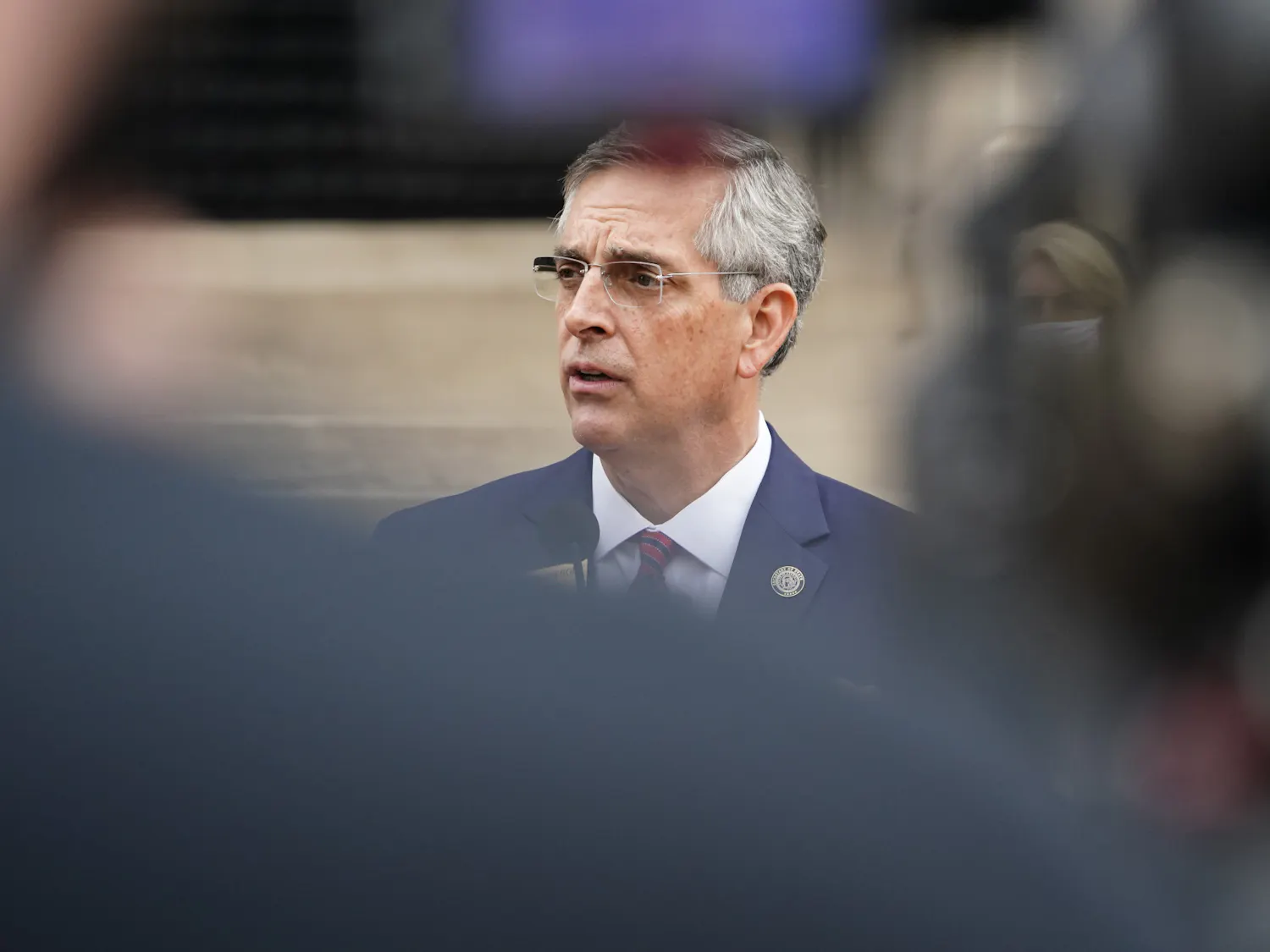
Trenton White

SGA general election results announced

Voter turnout on par with last year, officials say

Newly re-elected sophomore senator Khoi Le (center) expresses his delight just moments after his victory was announced in SGA's general election Wednesday. (MICHAEL DELLA POLLA/The Cluster)


Roughly one in four students cast a ballot in Wednesday’s SGA senatorial elections for the coming academic year, marking an official end to the spring campaign season.

SGA election officer Jamel Pee said an estimated 575 students turned out to vote in Wednesday’s campus-wide election. That’s mostly on par with last year’s turnout, Pee said.

A crowd of about two dozen onlookers gathered to watch as SGA election officials unveiled a banner displaying the results of the election around 6:20 p.m. Voting closed at 5 p.m.

Five of the nine candidates vying for Senator-at-Large won their bids to be elected. Sophomore Melissa Thompson led the way with 362 votes to carry the title of Leading Senator-at-Large.

Junior Sarah Brown followed not far behind with 324 votes, while Jonathan Cauthen, Gil Arquisola and Sage Harris each garnered the third, fourth and fifth place spots respectively by a 272-271-249 margin.

Eleven freshmen competed for the five open seats for sophomore senator. Dalton Turner narrowly edged out Nicholas Reynolds by a 155-154 margin to become the next sophomore class president. Mollie Davis, Austin Thompson and Ronnie Davis also won seats as sophomore senators, netting 139, 115 and 100 votes respectively.

All but one of the six candidates running for junior senator positions was elected to serve. Rodrigo Visbal won the job of junior class president over second-place finisher Khoi Le by a margin of 115-110. The three other junior senators elected were Justin Robinson with 104 votes, Branden Ryan with 92 votes and A.J. Patel with 82 votes.

In the race for senior senator as well, six candidates competed for a total of only five positions. Christina Vasquez narrowly beat out Kristen Blackwell to become the next senior class president in a 117-115 vote. Stephen Bradshaw, Matt Hickman and Matt Williams also won seats as senior senators by a 111-103-96 margin, respectively.

Outgoing SGA president Trenton White said that while he’s excited for the new slate of senators, he wishes more females had been elected. Only five of the 20 newly elected senators are females.

“It’s been a great turnout, but I’d like to see more women represented,” White said.

Despite the gender imbalance, however, newly re-elected senator Branden Ryan said he thinks the SGA slate represents a diversity of students from different backgrounds.

“I think we’ve got a very strong group with a broad range of interests this year, and I’m excited to serve,” Ryan said.

For more on this developing story, read the next issue of The Cluster, or check back in at www.mercercluster.com for updates.

SGA voted on March 14 to change the wording of Mercer’s Honor Code.

The motion to update the Honor Code was brought to the SGA floor by Vice President Shannon Giddens, who is also a member of Honor Council.

The Honor Council debated this decision carefully because the change also requires an alteration to The Lair, Mercer’s undergraduate student handbook.

Giddens abstained from the vote because she deemed it unethical to vote on the same piece twice.

Sophomores Khoi Le and Branden Ryan also abstained from the vote and freshman Nick Reynolds voted against the piece.

SGA and Honor Council agreed that the change is more beneficial because now it is a pledge about holding oneself to the highest level of academic integrity instead of simply saying “I won’t cheat.”

Branden Ryan decided to abstain from the vote as he felt there was some ambiguity that was not found in the previous version.

“I abstained because the updated text omits a certain degree of specificity that was found in the former version on what constitutes a violation of academic integrity at Mercer,” Ryan said.

The original honor code reads:

“I pledge myself to neither give nor receive aid during tests or for any individual assignments or papers, nor to use any information other than that allowed by the instructor. I further pledge that I will not allow to go unreported to the proper persons any violation of the Honor System and that I will give true and complete information to the Honor Council.”

The new official version reads:

“I pledge to hold myself to the highest standards of academic integrity while at Mercer University. I further pledge that I will hold my peers to these standards by reporting any violations I observe and that I will foster a spirit of honesty in the University’s academic environment.”

The Honor Code will be updated in the next edition of The Lair.

SGA President Trent White stressed the importance of students staying updated to changes in university policy.

“Hopefully this print story will reach a great number of students and they can be aware of the change,” he said.

Locke, Ekeke win SGA presidential election by landslide

Elected as new student body president, vice-president

Juniors Jordan Locke and Ike Ekeke were recently elected to serve as the new SGA president and vice president. Locke and Ekeke have served on 5 of the 8 standing committes during their tenure with SGA.


Juniors Jordan Locke and Ike Ekeke were elected last Wednesday to serve as the new SGA president and vice president for the coming year.

Election officials said 734 votes were cast. Locke and Ekeke won 477 of these, earning them 65 percent of the vote.

Locke’s supporters cheered on as the banner displaying the results was unveiled around 6 p.m. in Connell Student Center.

Locke and Ekeke ran on the campaign slogan “A Better Mercer,” and their platform focused on progressive feasibility.

Their other goals include: revamping the Bear Bikes program, continuing green initiatives, improving the implementation of student organizations, dealing with safety and parking issues on campus and working on SGA transparency.

“I’m very excited and honored to be able to serve the student body in this capacity in the upcoming year,”  Locke said.

Locke has served on the Public Relations and Elections Committee, has chaired the Macon Connections Committee and has chaired the Heritage Life Committee twice. Both he and Ekeke have served on the special committee for Bear Bikes.

Ekeke has served on the Student Life and Organization Affairs Committee, Contract Services Committee and on the special committee for Absence Legislation Reform.

Ekeke said thinking about all the students he could help in his new position motivated him to accept Locke’s request for him to be vice president. He also felt that he and Locke had similar ideas on campus issues and admired the work Locke had done on the Heritage Life Committee.

“I was excited that I would be getting to work with him and help out the student body,” Ekeke said.

Locke also based his decision to run on a desire to improve the student experience at Mercer. “I eventually made the decision to run because I’m very passionate about the university and making it a better place to go to school,” he said.

Locke said he is personally passionate about seeing the Bear Bike program thrive, but he feels another issue is of utmost importance to the student body. “I think that the issue I see as most applicable and beneficial to the student body is improving the number of cameras and lights in some of our under-covered outdoor lots.”

When asked what issue on his platform was most important to him personally, Ekeke said he would have a tough time deciding between SGA transparency and safety on campus.

“I feel safe [on campus], and I feel like we should take steps to make sure all students feel the same,” he said.

As for transparency, Ekeke hopes to utilize technology to communicate more effectively with students. One proposal on the table is to place a kiosk in the lobby of Connell Student Center to give students an opportunity to voice their opinion on current issues.

“When it comes to new technology, we always want to try it out,” Ekeke said.

Both juniors are excited about the results of the election and confident that they are up for the challenge.

“I, undoubtedly, am someone who pours their soul into their work. As SGA President, I will not hold myself to any other standard,” Locke said. “I believe that, between Ike and I, we cover a vast section of the student body and the comprehensive Mercer experience.”

“My legs got kind of weak when the banner was dropped,” Ekeke joked. “I’m very appreciative of the support from the student body, and I’m going to do everything I can to represent students as well as I can.”

SGA President Trent White expressed his enthusiasm for the year to come.
“I was very pleased with the platform they ran on, and I’m very excited to see what’s to come,” White said.

University-wide recycling program approved

New plan could come into effect as early as May

Juniors Shannon Giddens, Trenton White and Katie Martin worked with the administration and SGA to develop an effective recycling program for Mercer. The administration recently approved the campus-wide initiative.

SGA president Trenton White recently announced a new campus-wide recycling initiative that will be in full swing by fall 2011 and could come into effect as early as May.

Under the new plan, recycling bins for aluminum, paper and plastic products will be positioned across campus within easy reach of students, White said. The bins will be black in color and feature the Mercer logo as a way for them to fit in with the aesthetic feel of campus as a whole.

The units cost several thousand dollars each, but are made to last and will not need to be replaced for at least 10 years, White said. Five bins will be located by the dormitory dumpsters.

To prevent contamination –– a problem that has been common in past on-campus recycling efforts –– the units will feature different slots appropriately sized for different recyclables. The bins are designed for outdoor use and can withstand a variety of weather conditions.

The plan will also include a public education component meant to increase student awareness about the importance of recycling in their everyday lives, White said.

Both SGA and Physical Plant have amended their budgets to support the program. Student interest has made the program a reality.

White said he hopes the new recycling plan will help position Mercer as a leading regional institution in the area of environmental sustainability. More high school students are looking at green efforts when applying to colleges, and White said he thinks  having a program like this will encourage more students to apply to Mercer.

“We want this university to be on the forefront of recycling efforts. Compared to other schools, we haven’t always had the most comprehensive recycling strategies. But we’ve worked with what we had, and now we’re finally moving in the right direction,” White said.

White said that what sets the new initiative apart from other previously short-lived recycling programs on campus is that the new initiative includes broad-based support from the university administration, which will help make it more viable long-term by allowing existing university departments and infrastructure to help out in the process.

“Virtually everyone from the president to the dean, down to anyone in the administration, is in support of this plan. Many students have been passionate about this issue and led strong efforts in the past, but now we finally have everyone on board,” White said.

Katie Martin is the president of the Students for Environmental Action, the organization that has been tasked by SGA this academic year with helping to draft the new initiative. Martin said she’s excited about the prospects of the new recycling plan as a way to make Mercer a more environmentally friendly campus.

“We’re creating a lot of trash on campus, so it will be better in the long run for it to go to other facilities to be recycled,” Martin said.

SGA brought the plan directly to President Underwood, who agreed to move it forward and figure out the best way to bring recycling to students.

A problem that has been faced in the past was trying to find a company to buy the recyclables, especially in the recent struggling economy.

National, Mercer’s on-campus facility maintenance company, will collect the recyclables and take them to Physical Plant, which has large, separate trash bins for the products. Macon Iron will then come pick up the bins and take their contents to be recycled.

Macon Iron does charge a fee, but Mercer will earn some money back from the recyclables.

“Thinking long term, you pay to have your garbage taken to the landfill, so even if we’re not making money from recyclables, if we’re not paying more than the tipping fee for the landfill we’re still coming out ahead,” said Dr. Heather Bowman-Cutway, the SEA advisor and Mercer biology professor who will be overseeing the initiative.

The program will begin next fall, but Cutway said that as soon as the bins are in place. there is no reason to delay the process. Physical Plant is ready to begin and National understands its duty in the program.

Because recycling will not be a mandatory program, students will be required to provide their own dorm room recycling bins––for example, a cardboard box––and then take it outside to the bins to be organized.

While the most immediate push is to place the units as soon as possible, Cutway said that another goal is to place recycling bins inside campus buildings.

“The other place we want recycling offered is in academic buildings, particularly those which already have a vending machine area. That’s just a natural location to have recycling,” Bowman-Cutway said.

While the program will focus mainly on plastic, aluminum and paper, some days will be dedicated to recycling different materials. Last year, cardboard was recycled on Move-In Day and one huge dumpster was entirely filled with cardboard.

Faculty and staff have been working together and with the students to make the program work. Russell Vullo of Physical Plant has helped out in the process, Cutway said.

“It’s been a long time coming,” Cutway said. “I’m glad we’re finally getting up and running because it’s the right thing to do.

Cluster staff writer Carl V. Lewis contributed to this report.

SGA announced on Monday a new annual award to recognize an administrator, faculty or staff member in honor of former Dean of Students Dr. Barry Jenkins, who is retiring this year.

The Dr. Barry Jenkins Award for Ourstanding Contributions to Student Life will honor a Mercer employee each spring for commitment and dedication to student affairs.

SGA president Trenton White said the new award was established as a way to pay tribute to Jenkins’ long record of service to the Mercer community.

“Dr. Jenkins has always been a friends of students and had our best interests in heart. This award will help us remember him for years to come,” White said.

SGA senators submitted eleven nominations for the award during its senate meeting Monday night. The nominees include Jeremy Baham, Carol Bokros, Heather Bowman-Cutway, Megan Delong,Eimad Houry, Carrie Ingoldsby, Diane Lang, Dale Moore, Jim Netherton, Eric Spears and Annie Stephens.

Senators will vote on the award at their weekly meeting next week. The winner of the award will be announced at the annual Student Leadership Awards banquet on April 28.

Also during Monday’s senate meeting:

• SGA voted 22-1 to amend the honor pledge found in the Mercer student handbook, The Lair. Former Honor Council Chief Justice Douglas Doud proposed the change.
Doud said the new amendment to the honor pledge reflects a more positive statement of affirmation that falls in line with Mercer’s community of respect.

• SGA Vice President Shannon Giddens announced that the SGA presidential debate will be held next Tuesday, March 22. The debate will feature candidates for next year’s SGA president and vice president.

“This is an important event for students to attend so that they can get a better understanding of the issues that affect campus and can ask questions of their potential new representatives,” Giddens said.

The presidential election for SGA will be held the next day, March 23.

Cluster staff writer Carl V. Lewis contributed to this report.

Dean unveils new general education curriculum, changes core requirements

Changes replace FYS and SCP with new interdisciplinary courses, lower core requirements

Dean Lake Lambert recently unveiled a sweeping round of changes to Mercer’s general education curriculum for fall 2012, including replacing First Year Seminar and Senior Capstone classes with a new interdisciplinary program, lowering core requirements and adding a new writing focus to certain courses.

The new curriculum – called the Integrated Learning Program – will replace the courses previously known as FYS and SCP with a new set of classes called INT, which stands for Integrated Studies.
INT will cover topics of self-composition and community engagement similar to the ones in FYS and SCP, and will include an experiential component called INT-X.

The new curriculum also will reduce the amount of core credits needed for CLA students to graduate from 50 hours to 40 hours, Lambert said. Students will then be allowed to replace the extra 10 previously required hours with courses of their choice.

“The new general education requirements will fall in line with the core requirments at similar instutitions by making general education take up about one-third of the total credits needed to graduate,” Lambert said.

Lambert said one of the biggest benefits of the new curriculum is that it spreads interdsciplinary learning throughout the undergraduate experience rather than only in the freshman and senior years.

“Previously there’s been a bit of a gap with interdisciplinary studies. You take FYS in your freshman year and Senior Capstone in your senior year, but there’s not much in between,” Lambert said.

Lambert said the new curriculum has been in the works for a while now, but remains open to changes based upon faculty and student suggestions.

Student body president Trenton White said the new curriculum is not intended to lower Mercer’s standards but rather  to offer students a broader range of choice.

“The new coursework will just allow students to take more classes in their respective majors or elect to take other classes they find interesting,” White said.

The changes to the curriculum will also include a greater emphasis on teaching students analytical writing skills, Lambert said. Certain departmental-specific courses will be listed as writing-intensive classes and include a fourth hour for in-depth writing instruction.

“We hope that our renewed focus on writing instruction will help bring more focus to this area and will renew focus on how to teach faculty to teach students how to write,” Lambert said.
Another major difference in the new curriculum is that all students will be required to fulfill a community engagement requirement, which could include study abroad, internships or undergraduate research.

The new requirements will not affect current students, who will be grandfathered in under the new curriculum, Lambert said.

The Integrated Learning Program will have no signifcant effect on existing university programs such as Great Books, UNV, preceptorship or Peer Advising.

It will also nix the Scientific Inquiry requirement.

SGA announces university-wide recycling initiative

New program creates administration-backed recycling program

SGA president Trenton White announced on Wednesday a new campus-wide recycling initiative that will be in full swing by fall 2011 and could come into effect as early as May.

Under the new plan, recycling bins for aluminum, paper and plastic products will be positioned across campus within easy reach of students, White said. The bins will be black in color and bear the Mercer logo as a way for them to fit in with the aesthetic feel of campus as a whole.

The plan will also include a public education component meant to increase student awareness about the importance of recycling in their everyday lives, White said.

White said he hopes the new recycling plan will help position Mercer as a leading regional institution in the area of environmental sustainability.

“We want this university to be on the forefront of recycling efforts. Compared to other schools, we haven’t always had the most comprehensive recycling strategies. But we’ve worked with what we had, and now we’re finally moving in the right direction,” White said.

White said that what sets the new initiative apart from other previously short-lived recycling programs on campus is that the new initiative includes broad-based support from the University administration, which will help make it more viable long-term by allowing existing university departments and infrastructure to help out in the process.

“Virtually everyone from the President, to the Dean, down to anyone in the administration is in support of this plan. Many students have been passionate about this issue and led strong efforts in the past, but now we finally have everyone on board,” White said.

Katie Martin is the president of the Students for Environmental Action, the organization that has been tasked by SGA this academic year with helping to draft the new initiative. Martin said she’s excited about the prospects of the new recycling plan as a way to make Mercer a more environmentally friendly campus.

“We’re creating a lot of trash on campus, so it will be better in the long run for it to go to other facilities to be recycled,” Martin said.

SEA advisor Dr. Heather Bowman Cutway, a professor from Mercer’s biology department, will oversee the initiative.

For more on this developing story, read the next issue of The Cluster, or check back in at www.mercercluster.com for updates.

Cluster online editor Carl V. Lewis contributed to this report.

Dean unveils new general education requirements

Changes replace FYS and SCP with new interdisciplinary courses, lower core requirements

Dean Lake Lambert announced on Monday a sweeping round of changes to Mercer’s general education curriculum for fall 2012, including replacing First Year Seminar and Senior Capstone classes with new interdisciplinary classes, lowering core requirements and adding new writing courses.

The new curriculum – called the Integrated Learning Program – will replace the courses previously known as FYS and SCP with a new set of classes called INT, which stands for interdisciplinary studies.

INT will cover similar topics of self-composition and community engagement as FYS and SCP, and will include an experiential component called INT-X.

The new curriculum also will reduce the amount of core credits needed for CLA students to graduate from 50 hours to 40 hours, Lambert said. Students will then be allowed to replace the extra 10 previously required hours with courses of their choice.

Student body president Trenton White said the new curriculum is not intended as a way to lower Mercer’s standards, but rather as an opportunity to offer students a broader range of choice.

“The new coursework will just allow students to take more classes in their respective majors or elect to take other classes they find interesting,” White said.

The changes to the curriculum will also require students to take three new writing courses, Lambert said.

“We hope that our renewed focus on writing instruction will help bring more focus to this area and will renew focus on how to teach faculty to teach students how to write,” Lambert said.

The new requirements will not affect current students, who will be grandfathered in under the new curriculum, Lambert said.

The Integrated Learning Program will also have no effect on existing University programs such as Great Books, UNV, preceptorship, Peer Advising and study abroad.

For more on this developing story, read next week’s Cluster, or check back in at www.mercercluster.com for updates.

*Story updated March 1 to provide greater clarity.

BREAKING: Trolley service pushed back to 10 p.m. Friday

Service interrupted temporarily because of recent trolley fire

Mercer’s trolley service will not begin running until 10 p.m. tonight because of a scheduling conflict caused by the recent fire that destroyed the “Miss Molly” trolley last week.

Dean of students Doug Pearson said in an email Friday afternoon that he plans to meet next week with NewTown Macon – the group that operates the service – to ensure that the trolley schedule is not interrupted again in the future.

“Obviously (NewTown) is facing challenges as they deal with being down,” for the time being, Pearson said.

The trolley service has been operating under tight constraints after losing one of its two vehicles in an unexplained fire Friday near the University Center. NewTown’s other trolley, “Sweet Melissa,” has been running double time to pick up the slack.

Student body President Trenton White told The Cluster Friday afternoon that SGA would do whatever it can to make sure the trolley service runs smoothly in the coming weeks.

For more on this story, read the next issue of The Cluster, or check back in at www.mercercluster.com.